
The Red Tent
Posted: September 29, 2009 Filed under: Book of Sand 18 Commentsby Anita Diamant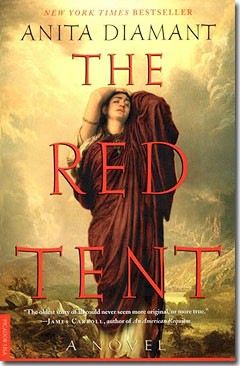
{ 1997 | St. Martin’s Press | 336 pgs }
I feel the need to preface my remarks by saying that I am extraordinarily easily influenced by others’ opinions when it comes to books and movies, which is why, ironically, I avoid reading reviews beforehand. My cousin let me borrow this book, saying merely that it “was well written” and that she “had strong feelings about it.” Of course, I interpreted that as a negative commentary. Being aware of my tendencies, I tried to counteract the pull to think of the book in negative terms.
Alright. Shall we begin with a summary?
The Red Tent is, according to the author, an attempt at Midrash, or filling in the gaps in Biblical narrative to aid in the understanding of the story. Diamant’s work is told from the point of view of Dinah, Jacob’s daughter who is mentioned only briefly in Genesis 34, where she is defiled by the prince of Shechem and her brothers take revenge on the city. This becomes the central event in The Red Tent and is preceded by narrative both about Leah & Rachel and Dinah’s history, and followed by an imaginative account of what happened to Dinah after Genesis 34. There is a great deal of emphasis on the relationships between the women in Jacob’s family; the title comes from the red tent to which the women retired for 3 days during the new moon/menstruation cycle.
And my thoughts:
What on earth is Diamant’s deep-seated hatred toward the Jewish patriarchs? She has virtually nothing good to say about Abraham, Isaac, and Jacob, and makes Joseph into an arrogant, self-important man during his rule in Egypt. The women in the story are consistently bitter towards the men, as well as condescending (in their gossip in the red tent, not directly). While Diamant certainly knows how to tell a story, she seems to be attempting to convince her reader that the Jewish heroes are actually horrible people. Dinah is full of hatred towards them and is portrayed as a strong and noble woman (like her mothers, Jacob’s wives), a stark contrast to the men in the story. Only four men are shown any respect: Dinah’s two lovers; Reuben; and Judah.
Diamant’s retelling changes a major detail. The rape of Dinah becomes Dinah’s consensual relationship with the prince, and the acts of her family are then cruel, vindictive, and motivated by Simeon and Levi’s violent, angry temperaments. Jacob changes his name to Israel out of shame, because people speak of the deeds of Jacob as evil. There is no sense of family unity or togetherness in the entire book except for when the women come together in the red tent. Maybe that was the author’s point, but it wasn’t believable.
It was interesting to read this on the heels of The Da Vinci Code (bleh), where the female divine is such a focal point. The women of The Red Tent are very much in tune with the earth, the seasons, and the supreme female goddess, to the point of having bizarre – really bizarre – rituals regarding menstruation. I’m not sure where Diamant got such ideas, but I was better off before I read them.
As I said, I really did try to counteract the negativity I felt towards the book. But despite the creative storytelling, I was disappointed with Dinah’s lack of maturity throughout the book. She describes her life from birth to death, but seems to mature only physically and never emotionally or mentally. At the end she was just as petty and critical of others as she was in the beginning. Her voice makes it clear that in her eyes, she alone is blameless. She hates Jacob for disowning Reuben (who slept with Rachel’s handmaid, Bilhah) and Judah (who, although the story does not mention it, slept with his daughter-in-law). Dinah is adamant that Reuben and Bilhah shared a true love and should not have been punished for their passion.
Maybe that’s what was most irritating about The Red Tent – despite being an attempt to portray how women lived during Biblical times, Diamant doesn’t care about the social constraints and rules of the period. Even if Dinah willingly went to the prince of Shechem, doing so before an official marriage would be considered immoral. I’m shocked that Dinah’s narration does not acknowledge this at all, and that it excuses Reuben’s act on the grounds of love. This is simply too modern an interpretation.
Also, I really hate the cover art. It’s hideously ugly.
I think that’s about all I have to say. Now that I’ve given you my negative view, why don’t you read The Red Tent and tell me what you think?
The Da Vinci Code
Posted: September 22, 2009 Filed under: Book of Sand 3 Commentsby Dan Brown
{ 2003 | Doubleday | 454 pgs }
The other night I spent 5 hours reading The Da Vinci Code for part of the Countdown Challenge I didn’t finish on time. Here is a partial list of other things I could have done instead:
- slept
- baked, decorated, and eaten a cake
- sifted through the neighbors’ trash
- composed a sonnet
- unraveled the blanket I’ve been crocheting
- made a paper mache house out of 454 pages of…some book
- completed my giant crossword
- crashed pots to make the Bwun wake up
- listen to the Bwun scream for 5 hours
- read the remaining 8 chapters of my Social Psychology book
- done a headstand
- walked on hot coals…in the backyard?
- hiked the Y alone at night
- scrubbed the bathroom floor
- caught up on the Romgi’s law school reading
- counted the perforations in our ugly laminate wall
- memorized pi to 100 digits
- hitchhiked to St. George
- played Wind Waker through again –
– ok, that was heartbreaking. Yes, it’s true, rather than play my favorite game I voluntarily read The Da Vinci Code in its entirety.
My apologies to Nintendo. It’s a sin I won’t commit again.
Deconstructing Sammy
Posted: September 18, 2009 Filed under: Book of Sand 2 Commentsby Matt Birkbeck
{ 2009 | Harper Paperbacks | 304 pgs }
Summary: Despite earning millions as an entertainer, Sammy Davis Jr. was heavily in debt by the time he died in 1990 and his estate was declared insolvent by the IRS. His widow, Altovise, rapidly deteriorates and is broke when she meets Albert “Sonny” Murray Jr., a former federal prosecutor. He agrees to try settling the debt with the IRS, thereby restoring rights to use the name and likeness of Sammy Davis Jr. and bringing money back into the family.
Sonny’s job is not easy, however, as he learns over the course of four years that Sammy had no sound financial plans and lived extravagantly, without thought for the future. Finding the necessary legal documents proves difficult as Sammy’s former associates and employees are hostile toward Sonny’s investigation. Altovise was not well-liked, and Sonny must deal with negative emotions both toward her and from her. A severe alcohol addiction means Altovise spends time in rehab, which incurs further debt and makes her difficult to work with.
Eventually, Sonny makes a deal with the IRS – Sammy’s estate must pay $360,000 in taxes, mere pennies compared to the $7 million owed. Finding the money is difficult, since it is nearly impossible to determine what music Sammy actually owned, what royalties are due, and so on. With a substantial personal loan from Piaget to Altovise, Sonny is able to pay the debt in several installments. A box set of Sammy’s music is released by Rhino. Things are looking up – until Altovise unexpectedly terminates her business relationship with Sonny, without paying him the $800,000+ in legal fees Altovise has incurred.
In the end, Altovise remains tied to shady business partners who cannot (or will not) bring Sammy’s estate back to the glamour it deserves.
My opinion: This was a fascinating subject for me. I knew almost nothing about Sammy Davis Jr., and it was interesting to learn how he gained and lost several fortunes. The legal battles seemed endless, and though I assumed (because here in my hands was a book about Sammy) that the estate was restored, I wondered if Sonny’s case would be successful.
Birkbeck is a talented author who skillfully narrates a complicated story. However, at times his writing becomes repetitive, taking on the tone of a high school research paper. My other complaint is that Birkbeck has apparently done so much research that he can’t bear to leave any details out of the book. For instance, in describing Sonny’s efforts to obtain some of Sammy’s possessions, Birkbeck mentions the host of Ripley’s Believe it Or Not and his wild behavior. “During a taping in China, [the host] was tossed out of the country after relieving himself on the Great Wall” (107). A humorous anecdote, but completely irrelevant to the actual narrative.
As a whole, Deconstructing Sammy makes an interesting journey for the reader – intertwining flashbacks from Sammy and Sonny with the quest to settle the IRS debt. I recommend it to those interested in biographies, entertainment, and complicated estate problems.
 Jarom
Jarom Mika
Mika hilleries