
Dragon Slippers
Posted: August 17, 2008 Filed under: Book of Sand 2 Commentsby Jessica Day George
So, here’s the thing: I have a list of all the books I mean to read, and I add to it whenever I hear of an interesting-sounding book. That means I have no idea where or how I heard of most of them, except the classics. Then again, maybe that’s an advantage, because I have no preconceived notions about “This book is recommended for people who like Harry Potter” or “Someone at church recommended this” or “Here’s a bestseller.” I hate preconceived notions about books and movies. I hate reading reviews.
Anyway, this is all leading up to something. I do remember that I saw the first few sentences of Dragon Slippers somewhere online, and they were hi-larious. I added it to my hold list at the library and it was ready to check out last week. I grabbed it to read to the Romgi on the way up to dinner at his parents’ house on Saturday, and then secretly (and maybe a little bit rudely) bundled up in my blankets to finish it alone later that night. (I am great at Silent Sustained Reading, but my voice wears out quickly and reading aloud is just so slow.)
Dragon Slippers was so much fun. I have only two complaints: first, the main character had an utterly ridiculous name — Creelisel. She went by Creel, which alone is just odd, but I like to be able to at least attempt pronouncing the protagonist’s name correctly. How do you say Creelisel? Cree-uhl-ih-zell? Honestly, it’s just ridiculous. My second complaint, as seconded by the Romgi (who finished it on his own yesterday), is that it got a little bit too girly in the middle. Other than that, the story was interesting, funny, and unexpected in the proper places.
And here’s what I was leading up to: after I was done reading, I looked at the back cover and saw that the author, Jessica Day George, attended BYU and now lives in Salt Lake. I’m glad I didn’t know that before, because it would have completely colored my reading of the book as a book written by a Mormon. I’d much rather enjoy the writing for itself than because I happen to share the author’s religion.
So. Now that I’ve spoiled that biographical detail for you, go read Dragon Slippers.
Oh, a third complaint — the cover is really ugly.
Murder on the Orient Express
Posted: August 12, 2008 Filed under: Book of Sand 2 Comments by Agatha Christie
This one counts as a real book, right? Not like that last one I read.
I’d like to say that the problem with discussing a mystery is that you can’t say much about the solution. You know, there’s a risk of giving too much away. I don’t know how many of you have read the book or have any interest in ever reading it, so it’s safest to assume you are all desperately clamoring to pick up a copy, having never read it before. Alright, alright! I won’t give away the ending!
In all likelihood I’ve never read an Agatha Christie book before. Not that I specifically remember, at least. We had tons of books growing up and I probably read 80% of the fiction on my parents’ bookshelves (note to self: Tom Clancy novels are not good reading material for 12 year olds). At any rate, this was my first “official” Agatha Christie read, and I must say I certainly enjoyed Poirot. He’s quite charming.
However, I’d like to (very vaguely) say that I didn’t much appreciate the solution. It felt much too contrived. And there were times when I thought Poirot was too insightful for his own good – almost to the point of being omniscient. Where’s the fun in that? Honestly! But, overall, it was a nice to read a murder mystery, and I’ll definitely seek out some more Agatha Christie in the future. Do you have a favorite to recommend?
My rating: 3.5 / 5 stars. According to the Romgi, my 5-star rating system is incredibly convoluted and ridiculous. 3.5 stars is the equivalent of a B+, meaning I liked the book but don’t feel the need to buy a copy to add to my collection.
Below is the full breakdown of my rating system. You tell me if it’s convoluted and ridiculous, ok? (The system also applies to movies.)
1 star = F. I hated it. Yuck. Waste of time.
2 stars = D or C, depending. I didn’t quite like it, but I got something out of it.
3 stars = B. I liked it, in kind of a “meh” way.
4 stars = A-. I definitely liked it and would buy a copy, on sale.
5 stars = A+. I loved it and need to buy it.
(In case you’re curious, I’m pretty sure this system is based off my idea of grades. Notice how B and A- are not good enough to get 5 stars? Yeah, maybe I’m obsessive about grades sometimes.)
Seven Daughters and Seven Sons
Posted: August 11, 2008 Filed under: Book of Sand 1 Commentby Barbara Cohen and Bahija Lovejoy
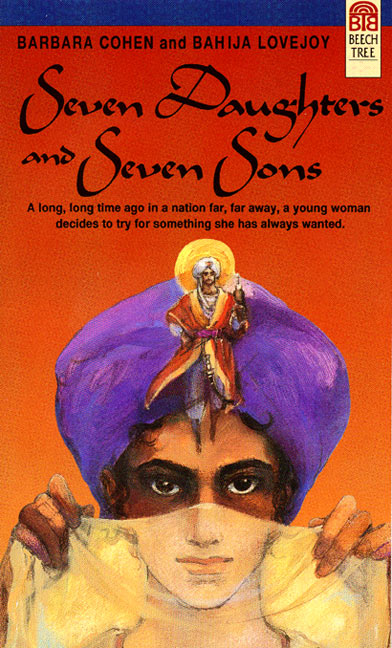 I’m sorry to say that the first new book I’ve read since March (aside from some great picture books I’ll review shortly) was this piece of fluff. There are no Wikipedia entries for the book or either of the two authors, which I take to be a bad sign. Actually, in hindsight, there were plenty of bad signs. But on with the review.
The story is based on an Iraqi folktale, and perhaps if either Ms. Cohen or Ms. Lovejoy were decent storytellers, I would have enjoyed the book. Broken into three parts, it tells of Buran, one of seven daughters of a poor shopkeeper. Her uncle is much more prosperous and has been blessed with seven sons. However, aside from this background information and one further scene involving Buran’s male cousins, there is no reason for “seven sons” to be part of the title. In fact, Buran’s sisters were included so infrequently that I couldn’t name a single one of them. This story is about Buran, who disguises herself as a man in order to travel to distant lands and set up a shop, thereby becoming infinitely wealthy and raising her family out of poverty.
Does Buran sound at all like Mulan to you? And I mean the story, not just the name, which we’ll assume is coincidence. Also, can you guess that Buran makes a very close male friend (who happens to be a prince) with whom she begins to fall in love? Yes, the prince even begins to suspect – hope? – that Buran (aka Nasir) is actually a woman, and tries several tests to find out. Of course, since the last test involves a public bath, Buran has no choice but to leave the city with all her riches, travelling far and wide in an effort to exact revenge on her male cousins. When did they come back in the story, you ask? No one is really sure. But they do turn up, and are humiliated when Buran more or less turns down their marriage proposals.
Anyway, there is a happy ending (did you expect anything else?) in which Buran and her prince are reunited, this time as a man and woman who are free to love each other. How predictable.
My two biggest complaints: first of all, I may not be much of a writer, but I can recognize good writing. I found none here. The writers started the book with the sort of flowy language one would expect from a Persian-y feeling story, but quickly deteriorated into “I’m coming, Father,” or “My heart felt sick with worry” (not actual quotes). Secondly, there was way too much about the prince’s concubines. Although the story is written at the level of ten or eleven year olds, there was really no reason to mention the prince calling for the girl who “pleased him best.” Seriously!
You may be wondering why I read it at all. Well, I was at Krista’s house with nothing to do for an hour and a half, and I couldn’t find the tv remote. (Hey! I don’t watch tv at home, it’s fair!)
My rating: skip it.
 Jarom
Jarom Mika
Mika hilleries