
Dragon and Thief
Posted: December 29, 2010 Filed under: Book of Sand Leave a commentby Timothy Zahn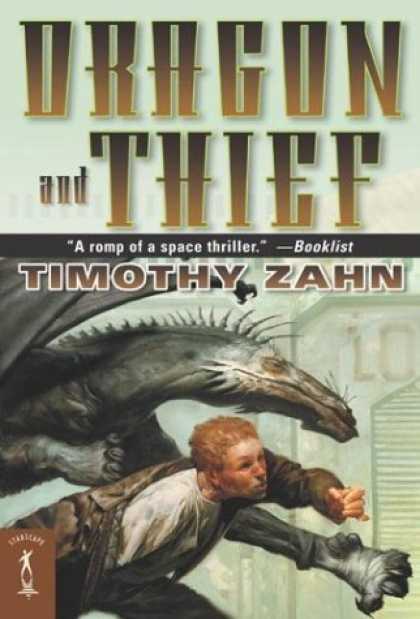
{ 2003 | Tor Books | 256 pgs }
I’ve never been so embarrassed to admit liking a book.
Dragon and Thief is the first book in Zahn’s Dragonback series. From the first page, it was laughably bad. The writing really is atrocious and I read several passages to the Romgi so he could shudder, too. And yet…I hate to say it…once I got past the poor quality of the writing, the plot was actually interesting. In fact, it was so engrossing that (please forgive me) I want to read the other books in the series now.
The plot doesn’t save everything: one of the major problems with any sci-fi/fantasy novel is the inability of the author to effectively communicate their own unique sci-fi/fantasy elements. For example, in Dragon and Thief, one of the main characters, Draycos (yes, Draycos), belongs to a race called the K’Da; the K’Da are three-dimensional beings who require a host on whom they can become two-dimensional. Does that make sense? If it does, I’ve done a better job explaining the concept than the author did. Draycos is the first character to be introduced in the book and until the second main character, Jack Morgan, comes along, there’s not much more explanation about the 2D/3D thing. Confusing. And, like so many books of the same genre, Dragon and Thief is not very imaginative (apart from the K’Da and their strange properties).
That being said, I stand by my enjoyment. Once I was able to more or less tune out the bad writing, it was a quick, fun read.
But in all honesty, I’m still embarrassed to recommend it…
The Good Women of China
Posted: December 14, 2010 Filed under: Book of Sand 2 Commentsby Xinran
{ 2002 | Pantheon | 256 pgs }
As the only nonfiction book I’ve read this year, The Good Women of China: Hidden Voices already stood out. But the author’s exceptional writing, in addition to her captivating subject matter, made the book unforgettable.
Xinran was a radio broadcaster in China during the 1980s and 1990s; she wrote The Good Women of China – which recounts some of the stories she collected through interviews on and off her radio program – after leaving the country. One of her goals was explore how Chinese women perceive themselves and their place in society, particularly at a time when social dynamics seemed to be rapidly changing. Most of the stories directly or indirectly involve the Cultural Revolution. Many are heartbreaking.
I admit I know relatively little about China, or Chinese culture and society. Xinran patiently explained so that I could follow along and understand (with the help of my great sociological mind) enough to form a mental framework in which to place her stories. The Good Women of China earns a strong recommendation from me, with a word of caution: this is not light, cheerful reading. The book contains mature themes and, in my opinion, requires a certain degree of solemnity from the reader.
Persuasion
Posted: December 9, 2010 Filed under: Book of Sand 3 Commentsby Jane Austen
{ 1818 | John Murray | 336 pgs }
I don’t often read romance novels of any sort, even if they are famous. Austen’s stories are so achingly predictable that you know from the instant Mr. Right is introduced as a character that the rest of the book will be spent NOT having him get together with our heroine – until the very end, of course. In fact, with few alterations, I think the story of how the Romgi and I ended up married would make a fantastic Austen plot. But that’s for another time.
In my younger years, I read and loved Pride & Prejudice, but looking back I wonder if perhaps I felt obligated to enjoy it. Maybe part of it was my sense of dreamy romance, which was much stronger at the time. (Another possibility: because I read it at a time when the Romgi and I were NOT getting together, I identified much more with Elizabeth. Hmm.) Truth be told, the only other Austen novel I’ve actually read is Emma, which was so identical to the Gwyneth Paltrow film that I sincerely wanted to stop reading and just go watch the movie. I have seen my share of Austen adaptations, which is why I feel justified in making sweeping judgments about her actual literary works. There’s smugness for you!
At some point, I know I’ve seen part of an adaptation of Persuasion, but I wasn’t paying much attention, and when I started reading the book, I had only an extremely faint idea what the plot would be (outside of the general “how to get Mr. Right” formula). Whether from my low expectations or because the book was truly good, I – shockingly – enjoyed it! Yes, it was somewhat tedious to wade through the chapters of NOT getting together, but I was appeased by my confidence that Anne and Captain Wentworth would at last have their happy ending. Real-life analogy: it’s not so painful now to think of the dramatic breakups and heartaches that the Romgi and I went through, because we’re blissfully married now. Right? (The Romgi, now is a good time to leave a comment in the affirmative.)
Another factor in my enjoyment of the book was Anne’s character. I never felt as though Austen was trying to compel or persuade (tee hee) me to like Anne above any other characters, nor that she (Anne) was simply less boring or stupid than everyone else. Anne came across as a somewhat average woman, which is how I feel most of the time. The plot didn’t involve two supremely attractive and likable characters instantly falling in love and getting married; rather, it was two regular people who were able to make their relationship work. They adored each other as couples ought but never glorified the other in the extreme. Yup, good stuff.
With my happy results from having read Persuasion, I may be daring and try another Austen novel. As I mentioned before, I’ve only read Emma and Pride & Prejudice before. What would you recommend?
 Jarom
Jarom Mika
Mika hilleries