
Heart of Darkness
Posted: December 22, 2011 Filed under: Book of Sand Leave a commentby Joseph Conrad
{ 1899 | Blackwood’s Magazine | 136 pgs }
Heart of Darkness appears on just about every list of “Books You Must Read to Be Considered a Real Reader,” and I know a lot of people read it in high school. Not me. I didn’t even read some of the assigned reading for my English classes (yes, you, Scarlet Letter). I naturally assumed that saving this classic for a time when I’m a mature and knowledgeable person would permit deeper understanding and appreciation for the book. Sadly, I appear to have been wrong.
Maybe CliffsNotes would have helped me?
I think I just didn’t quite connect with the book. It’s been a few months since I read it, and it feels…unmemorable. Except the memorable parts. I like the story-told-in-a-story format, but I missed the point of the literary technique here.
I’d really love to hear input on the significance of the book, what I ought to have gotten out of it, how I can look for a better connection or more meaning if I read it again (which will happen only if you’re very persuasive). Was this assigned reading for your high school English classes?
Buy Heart of Darkness on Amazon
The Guernsey Literary and Potato Peel Pie Society
Posted: November 21, 2011 Filed under: Book of Sand 2 Commentsby Mary Ann Shaffer and Annie Barrows
{ 2008 | The Dial Press | 288 pgs }
I’m secretly a little disappointed that this book was good. I didn’t expect it to live up to its hype. Or maybe I just wished I had more unique taste than “the masses.” Honestly, that’s the same reason I held off on reading the Harry Potter series…what’s my deal?
Alright, so The Guernsey Literary and Potato Peel Pie Society is written entirely in letters (with the odd telegram thrown in) and takes place during WWII. It’s amusing, touching, interesting, and educating (insofar as it’s historically accurate, of course). For a moment I was going to say that the only two epistolary (!) books I’ve read were both British, but I remembered that Dear Mr. Henshaw is another – and definitely American. (The other British book was Sorcery and Cecilia. But – silly me – I also read its sequel, The Grand Tour, which I guess makes four epistolary novels I can think of at the moment.) Back to where I was, though: TGLAPPPS was every bit as good as I had heard. My only complaint is that despite its solemn topic and sometimes tragic storyline, at the end I almost felt as if it lacked substance. The plot finished a little too neatly and happily.
Have you read it? Am I way off here? Maybe I just wanted some tiny aspect to criticize so I felt superior to the masses…
Buy The Guernsey Literary and Potato Peel Pie Society on Amazon
Crime and Punishment
Posted: August 17, 2011 Filed under: Book of Sand 1 Commentby Fyodor Dostoevsky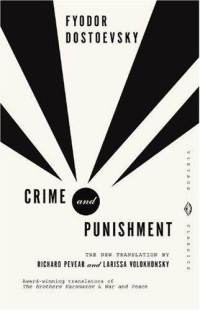
I’ve always been an avid reader, but classics intimidate me. My high school English classes went through quite a few – although, that means I have only a tenth-grade understanding of books like Moby Dick (is it worth trying again?) and zero understanding of The Scarlet Letter (I confess, I barely skimmed the CliffsNotes) or Far From the Madding Crowd (I had a friend summarize it for me. Thanks, Alicia). I feel like, as an adult – an intelligent and literate adult, at that – I have a responsibility to read the classics. Surely they are justly deemed to be great works of literature, right? I think my hesitance comes from my underwhelmed reaction to many of the classics I read in high school.
I started reading Crime and Punishment before I had kids. It may have even been before I was married. I absolutely loved the first few chapters – and then, the book was suddenly overdue. I tend to check out a half dozen books at a time and rack up immense library fines. (Don’t worry; I’ve since banned myself from the library.) A year or so after I started Crime and Punishment, I checked it out again, but I couldn’t find my place, so I began reading from the beginning. I got to approximately the same spot and, once again, I got distracted by other books and ended up paying a fine for my late returns. Fortunately, last year for my birthday the Romgi bought me a Kindle, and I downloaded a free copy of Crime and Punishment – no fees, regardless of how long it took me to read.
Well, it was several months. I started from the beginning and was determined to get through it, partly because I made it a goal on my list of 101 things to do in 1001 days. And I still loved it. I’d gotten used to the feel of the first few chapters and I was surprised, pleasantly, when the tone shifted a little and the plot expanded. I had no idea there would be a large cast of characters (I really am ignorant, aren’t I?) or that the plot would involve more than just the eponymous crime. (Please tell me I’ve correctly used the word eponymous here. It might be the first time I’ve actually used it and I’d hate to ruin the experience.) Obviously, punishment is part of the story as well, but the book was much different from the vague idea I had in my head. (I have no idea where or how I formed my idea of the book.)
Are you still with me? You’re so great.
Crime and Punishment did not disappoint. It was wonderfully written – the storytelling and translation were both excellent. This definitely deserves its status as a classic. It shouldn’t intimidate you. I found that reading up on Dostoevsky after finishing the book, rather than before, made me appreciate the story much more. Do you like to learn some background information about the author before you read a book?
When I feel up to it, I want to re-read The Stranger and compare it to Crime and Punishment. I suppose it’s been done before. It seems like an obvious comparison – but quite fascinating. Have you read both? What’s your opinion?
 Jarom
Jarom Mika
Mika hilleries