
Difficult Conversations
Posted: December 23, 2011 Filed under: Book of Sand Leave a commentby Douglas Stone, Bruce Patton, & Sheila Heen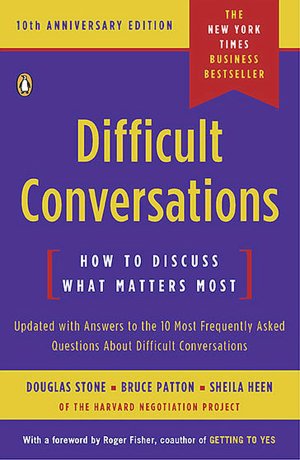
{ 1999 | Michael Joseph | 272 pgs }
Friends, this book will change your life. I mean it.
Jarom and I considered giving a copy of this to everyone on our Christmas list. We’re poor, so we didn’t end up doing it. But we would have liked to. Expect a copy from us at some point.
Difficult Conversations: How to Discuss What Matters Most was a required book for Jarom’s negotiation class this past semester. It’s written by some of the founders of the Harvard Negotiation Project, part of the Harvard Law School, which aims to help people avoid litigation as a form of problem-solving. The book is meant to examine how and why we confront others (or try not to confront them), and it is, no kidding, life-changing.
There are always disagreements, right? Here’s a recent example:
We stayed with Jarom’s sister and brother-in-law for a couple days of our Christmas vacation. I read tons of books and the night before we left their house, I was up late (who knows exactly how late?), engrossed in a really good book. In the morning, Jarom got up with the kids and let me sleep in. I picked the book up as soon as I woke up, desperate to finish before we left. I managed to finish about half an hour before we needed to leave, so I rushed around packing our things and trying to convince Evan to get dressed (he loves pajamas lately). In the meantime, Jarom was enjoying a final game of Agricola. I was extremely huffy and abrupt as the gathered our things, since the game showed no signs of ending in time for us to leave. (We planned to visit with a friend at my parents’ house, and the scheduling, to me, seemed tight.) I snapped at Jarom more than once and made no effort to hide my frustration that I was doing all the packing myself while he played a game that was obviously going to make us late. Finally he said, “The way I see it, you got to sleep in and then finish reading your book. If we’re pressed for time, that’s your fault.”
Even though Jarom and I both read and loved Difficult Conversations, it’s tricky to keep its lessons in mind when tempers flare. The book is about learning to deal with hurt feelings and tempers and sticky situations by understanding ourselves and listening to the other person.
I’ve been aware for quite some time now that I panic when I think we won’t be on time for something, even if there’s no real consequence to being late. So that was a big factor in my frustration. It was probably the main reason I was upset. I wanted to have a quick shower before we met with our friend, and the time crunch made it unlikely, especially if Jarom’s game took a long time and we were behind schedule in heading out. I was worried about leaving things behind, and about Evan throwing a fit, and about June waking up from her nap and wanting extra attention when I was in a hurry. But instead of addressing any of those issues, I was irritated with Jarom for being involved in a time-consuming game.
Maybe Jarom will chime in about how he could have responded differently, but he’s usually pretty laid back; I think he was careful in framing his words with “The way I see it…” so it was clear that this was his perception, his interpretation of my actions. Really, he had no way of knowing that my stress was coming from the how-do-I-handle-everything-without-being-late fear, since all I said was “Is your game going to be over soon?” several times, with increasing frustration.
What I liked most about the book was how it encouraged allowing emotions into conversations. Even if they aren’t directly brought up, emotions are what drive us; trying to leave them out ignores a huge part of human life.
This has probably been a terrible, unconvincing summary. But when I read Difficult Conversations, it was like my eyes had been opened. I interact with people differently now – hopefully in a better way. Please read it!
Buy Difficult Conversations on Amazon
The Help
Posted: December 22, 2011 Filed under: Book of Sand Leave a commentby Kathryn Stockett
{ 2009 | Putnam | 464 pgs }
I would never trade sleep for reading a book.
…
Well, anyway. I did this time, like many times before. The Help, as you probably know, is set in the South in the 1960s. So of course it’s about race. There are lots of books like this. Unlike The Secret Life of Bees, I felt like The Help had a more original approach to the subject, and it was enjoyable. Unless you are cut off from both books and movies, I assume you know that The Help is about a young white woman and the experiences of black servants in Jackson, Mississippi.
While the book was enjoyable, I didn’t come out feeling like I’d learned any lessons or gained any insight (aside from the “Thank heavens for the civil rights movement” thought the author intends you to have). The thing is, I’m more interested in how this same inequality is perpetuated today. I can’t help but think that it must still be there – here? – in a different form. Don’t you wonder how racism still affects people now?
P.S. It’s been a little while since I read the book. Can you remind me why there are birds on the cover? Is that relevant?
Heart of Darkness
Posted: December 22, 2011 Filed under: Book of Sand Leave a commentby Joseph Conrad
{ 1899 | Blackwood’s Magazine | 136 pgs }
Heart of Darkness appears on just about every list of “Books You Must Read to Be Considered a Real Reader,” and I know a lot of people read it in high school. Not me. I didn’t even read some of the assigned reading for my English classes (yes, you, Scarlet Letter). I naturally assumed that saving this classic for a time when I’m a mature and knowledgeable person would permit deeper understanding and appreciation for the book. Sadly, I appear to have been wrong.
Maybe CliffsNotes would have helped me?
I think I just didn’t quite connect with the book. It’s been a few months since I read it, and it feels…unmemorable. Except the memorable parts. I like the story-told-in-a-story format, but I missed the point of the literary technique here.
I’d really love to hear input on the significance of the book, what I ought to have gotten out of it, how I can look for a better connection or more meaning if I read it again (which will happen only if you’re very persuasive). Was this assigned reading for your high school English classes?
Buy Heart of Darkness on Amazon
 Jarom
Jarom Mika
Mika hilleries