
Samson's Walls
Posted: January 20, 2010 Filed under: Book of Sand 1 Commentby Jud Nirenberg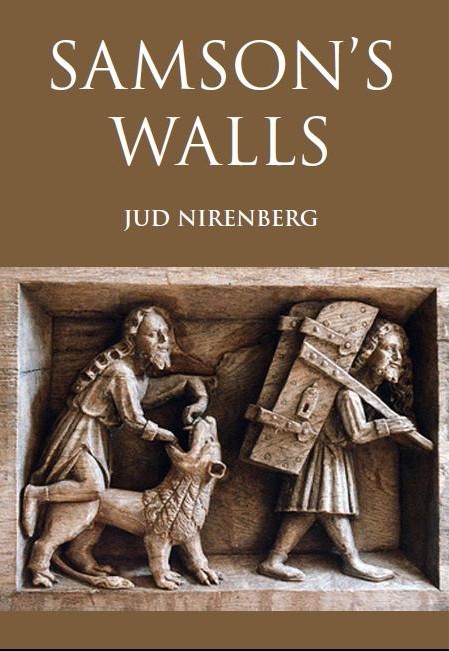
{ 2010 | Paul Mould Publishing | 169 pgs }
You probably know the basic story of Samson: an angel appears to his mother and informs her that she’ll bear a son who is to be a Nazarite, Samson is born and is strong, he marries a Philistine, she tricks him, he kills a bunch of people/animals, he hooks up with Delilah, she tricks him, he’s captured by the Philistines, he loses his sight but eventually regains his strength, he topples a building on top of himself and a bunch of Philistines.
More or less.
Like The Red Tent, Samson’s Walls is an attempt to fill in some of the gaps in the Biblical version of the story. While the elements Nirenberg has added make for a scintillating read, I feel very strongly that these elements are almost entirely a product of our modern way of thinking. The way the characters are portrayed does not seem realistic when you consider the interpersonal relationships and societal norms of the time period. And although Samson was always one of my favorite Biblical characters (for reasons I can no longer recall), Nirenberg’s characterization had me hating Samson within a matter of pages.
Because I read a pre-publication unbound copy of the book, I cannot guarantee that what I saw was the final version. However, in my copy, there were endless typos and grammatical errors on top of the amateur writing. I was disappointed that Nirenberg seemed unable to make the story – either the original Biblical narrative or his own interpretation – plausible. From completely unnecessary swearing to uncomfortably, pornographically descriptive sex scenes, Samson’s Walls felt like the author’s intention was to get a movie deal. I’m sure it would do well on the big screen, since it has many best-selling features: revenge, killing, prostitutes, sex, and an overriding focus on the self. In the hands of a more talented author, perhaps it could have been a best-selling book, as well.
Austenland
Posted: January 20, 2010 Filed under: Book of Sand 1 Commentby Shannon Hale
{ 2007 | Bloomsbury | 208 pgs }
This piece of fluff had a disappointingly happy ending. I read it because there was nothing else to read in our house (aside from the Romgi’s other textbooks, which I didn’t want to pick up at 11pm).
The main character, Jane (!), has a secret Mr. Darcy crush, and compares every man she meets to her Darcy ideal. When her great-aunt, who knew about the secret crush, dies, in her will she gives Jane a trip to a Jane Austen pretend-a-thon. Basically there’s an estate in the English countryside where you pay to play make-believe, like you live in Regency England and are an attractive, eligible young woman. The whole point was really for Jane to get over her fantasy, but [SPOILER] she has a happy, blissfully romantic ending anyway.
Dumb.
(For the record, this is why sometimes I won’t read other books by favorite authors.)
The Anatomy of Peace
Posted: January 20, 2010 Filed under: Book of Sand Leave a commentby Arbinger Institute
{ 2006 | Berrett-Koehler Publishers | 231 pgs }
I was originally planning to take a class on campus this semester, titled Self & Society. It examines how we form our identities and how we interact with other people, among other things. This was one of the assigned texts, and I figured I might as well read something before I got busy with school and the Bwun and so on. It took me about an hour and a half – it isn’t a textbook, and on top of that, it’s fiction. Ea-sy read.
At a wilderness camp for out-of-control teenagers, parents are asked to stay two days with the camp’s leaders and learn how to resolve the conflict in their homes – not by fixing the teenagers’ behavior, but by adjusting their own attitudes and behaviors. The philosophy of the book is that when we act with our hearts at peace towards ourselves and those around us, harmony is possible; when we act otherwise, we invite conflict.
Definitely an interesting book, and I’d recommend it to those who feel angry, bitter, slighted, or resentful – so, to all of us, at times.
 Jarom
Jarom Mika
Mika hilleries