
Things Fall Apart
Posted: December 15, 2008 Filed under: Book of Sand 2 Commentsby Chinua Achebe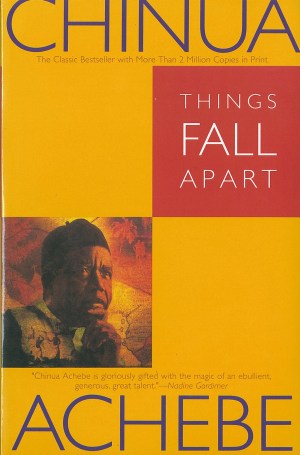
You may be surprised that I’ve never had to read this book for a class. Most people I know were assigned to read it at some point. I guess in all my linguistics/family history/English/sociology majors, we never got around to it – which, I’ll say now, is too bad. I would have liked discussing it with a big group of people.
The Romgi has been recommending Things Fall Apart for a while. He told me it’s really sad. I mentioned the book to a friend recently who said it’s depressing. Naturally, I was prepared for a horrifically sad, depressing story; but with only 10 pages left to go, I hadn’t come across anything of the sort and wondered if the Romgi was thinking of another book or if the last few pages were going to be extra intense (and sad).
Actually, the book made me angry. Not sad or depressed. Just angry that there is so much tendency to force our ideologies on others whenever we feel that their ways are inferior to ours. (I will not get into politics here.) A combination of the way I was raised, my religious views, and my excellent sociological training has shaped the way I perceive the world, and I really think that for the structures of society, economics, and culture, there isn’t one “right” way of doing things. Capitalism works well in the U.S. (more or less), but that doesn’t mean it’s the only acceptable economic system or that it’s right for everyone else. Same with the type of government we have. Same with western culture. Just because it’s what We do (and, sadly, usually We = Europeans and their descendants) does not mean it’s what They should do.
Ok, that being said, Things Fall Apart is also an incredibly interesting book to read because of the writing style. Very different from anything I’ve read before. And definitely enjoyable.
I didn’t mean to suggest that I disliked the book at all – just that it made me angry. Especially because so many people have read the book, become sad or angry or depressed because of the mindset of the colonial powers, and still today are convinced that in many ways We are superior to Them and They need our help to be brought out of their backwards culture/economy/society. Wrong.
I Am Rembrandt's Daughter
Posted: December 10, 2008 Filed under: Book of Sand 2 Commentsby Lynn Cullen
A while ago, when the Romgi decided it would be more fun to spend 3 months in Korea than propose sooner so we could just get married, I was driving from California to Utah by myself and picked out some audiobooks to help me stay awake. And entertained. One of them was Girl With a Pearl Earring by Tracy Chevalier. I usually stay away from historical fiction – something about it just really bothers me. But I do like Vermeer, and I thought Chevalier’s novel was a rather interesting take on Vermeer’s life and paintings.
I tell you this because I only got I Am Rembrandt’s Daughter because it was basically the same book, but focusing on a different painter, and targeted towards a younger audience. And now I unequivocally reaffirm that I don’t like historical fiction.
Problem #1 with the book is that I predicted both of the major plot twists at least 20 pages before they happened. Again: if I can figure it out, it’s too obvious. I shut off most of my higher thinking powers when I read fiction (perhaps a bad idea, but I firmly believe it lets me enjoy books more easily than I would otherwise), which means that I’m not trying to guess ahead. To have accurately predicted the twists here was immense. And disappointing.
Problem #2 is that the character development went really well until about page 280 (of 320), at which point everyone (excluding the main character, I suppose) completely changed their behavior. The love interest who had been compassionate, warm, and caring suddenly became selfish; the mysterious man who had been standoffish and somewhat rude suddenly became fatherly. Both changes occured within a page of each other. That’s too much at once. I think, given the circumstances, neither change was really necessary, and only served to weaken Cullen’s characters.
Problem #3 is one of the big reasons I avoid historical fiction. Our current ways of thinking were used for 17th-century people in ways that probably aren’t accurate. It seems wrong to assume (very wrong) that society has always been similar to the way it is now, that our views on humanity have remained the same. Example: the main character felt a strong dislike towards some of her richer counterparts because of their lack of compassion for slaves and servants. When the mysterious/fatherly man offers to send a servant to check on the girl’s brother, who has the plague, the girl (sorry, I can’t remember her name) is shocked that the man has so little concern for his servant’s health. Now, they do make a point of saying that slavery has been outlawed in Amsterdam, and I could understand if an adult were passionate about the issue. But for an almost-14 year old who has clearly not been influenced by the grownups in her life to have the attitudes she does – it isn’t realistic. Just because we feel strongly today about how we treat those in poverty or slavery doesn’t mean that teenagers several centuries ago felt the same! Ridiculous!
So…obviously, I didn’t care for the book. Yuck.
I Am Rembrandt's Daughter
Posted: December 10, 2008 Filed under: Book of Sand Leave a commentby Lynn Cullen
A while ago, when the Romgi decided it would be more fun to spend 3 months in Korea than propose sooner so we could just get married, I was driving from California to Utah by myself and picked out some audiobooks to help me stay awake. And entertained. One of them was Girl With a Pearl Earring by Tracy Chevalier. I usually stay away from historical fiction – something about it just really bothers me. But I do like Vermeer, and I thought Chevalier’s novel was a rather interesting take on Vermeer’s life and paintings.
I tell you this because I only got I Am Rembrandt’s Daughter because it was basically the same book, but focusing on a different painter, and targeted towards a younger audience. And now I unequivocally reaffirm that I don’t like historical fiction.
Problem #1 with the book is that I predicted both of the major plot twists at least 20 pages before they happened. Again: if I can figure it out, it’s too obvious. I shut off most of my higher thinking powers when I read fiction (perhaps a bad idea, but I firmly believe it lets me enjoy books more easily than I would otherwise), which means that I’m not trying to guess ahead. To have accurately predicted the twists here was immense. And disappointing.
Problem #2 is that the character development went really well until about page 280 (of 230), at which point everyone (excluding the main character, I suppose) completely changed their behavior. The love interest who had been compassionate, warm, and caring suddenly became selfish; the mysterious man who had been standoffish and somewhat rude suddenly became fatherly. Both changes occured within a page of each other. That’s too much at once. I think, given the circumstances, neither change was really necessary, and only served to weaken Cullen’s characters.
Problem #3 is one of the big reasons I avoid historical fiction. Our current ways of thinking were used for 17th-century people in ways that probably aren’t accurate. It seems wrong to assume (very wrong) that society has always been similar to the way it is now, that our views on humanity have remained the same. Example: the main character felt a strong dislike towards some of her richer counterparts because of their lack of compassion for slaves and servants. When the mysterious/fatherly man offers to send a servant to check on the girl’s brother, who has the plague, the girl (sorry, I can’t remember her name) is shocked that the man has so little concern for his servant’s health. Now, they do make a point of saying that slavery has been outlawed in Amsterdam, and I could understand if an adult in the book were passionate about the issue. But an almost-14 year old girl who has clearly not been influenced by any grownups having these attitudes is unrealistic. Just because we feel strongly today about how we treat
 Jarom
Jarom Mika
Mika hilleries