
Beyonders
Posted: May 17, 2011 Filed under: Book of Sand 1 Commentby Brandon Mull
{ 2011 | Aladdin | 464 pgs }
You may recall that both the Romgi and I are big fans of author Brandon Mull – he wrote the Fablehaven series and The Candy Shop War. Earlier this year, the Romgi came back from a trip to the bookstore with Mull’s newest work: Beyonders, or possibly A World Without Heroes (Beyonders). I’m still not exactly sure what the full title is or how I should reference the book. For now, I’ll stick with Beyonders. It’s the first in a new series and…holy cow, guys. Do you ever listen to my recommendations? Do it now! Read this book!
Beyonders is the story of a regular kid who gets mysteriously transported to another world. If that sounds familiar, it’s ok. When I sit back and think about it, many of the elements of Beyonders are your typical fantasy-adventure fare. The great thing about it is that it feels original. Even though it’s another circumstances-call-for-a-hero book, it’s believable! How often do you encounter a book like that?
As always, I’m hesitant to say too much about the plot. It’s such a captivating read that I really just suggest you go get a copy and sit down with it. The kids were nuts yesterday but I still managed to read Beyonders while the Romgi was at work. So worth it! For comparison, I think Beyonders is a little like A Wrinkle in Time and The Riftwar Saga (by Raymond E. Feist). And maybe The Wee Free Men, but I haven’t read that in so long – I could be wrong about the similarities. Anyway, if you’ve never read all of those books, you ought to. But first go read Beyonders. I’m not joking, this book is SUPER GREAT. Definitely one of my new favorites!
Buy Beyonders at Amazon
Heidi
Posted: May 13, 2011 Filed under: Book of Sand Leave a commentby Johanna Spyri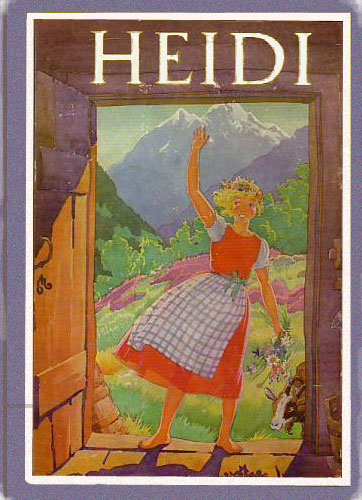
{ 1880 }
As a little girl I always pictured Heidi sitting in the sun on a mountaintop, with her hair in braids crossed over her head. I must have gotten the idea from a book cover I saw somewhere, and it got mixed up with the opening scene from The Sound of Music. But I’d never read the book or seen the Shirley Temple film until recently.
You don’t mind spoilers, do you? Chances are you already know the story of Heidi, and even if you don’t, there isn’t much to give away. Heidi is a sweet little girl whose parents died when she was young, and her aunt has been raising her. The aunt gets tired of it and takes Heidi to live with (Heidi’s) grandfather on a mountaintop in the Swiss Alps. Of course, the grandfather is crotchety and surly, but he takes an instant liking to Heidi. They live happily until the aunt comes back and snatches Heidi, because the aunt promised to bring a little mountain girl for a rich invalid girl to play with in Frankfurt. Heidi is quite miserable in her new surroundings, and they won’t allow her to go back home to her grandfather – until she becomes ill from severe homesickness. Then everything is wonderful on the mountain again, and when the invalid girl (Clara) comes to visit, she slowly regains strength and health and is able to walk again. Joy! The end!
If it sounds like a simple and sweet story, it is. Honestly, it was a much-needed refreshment after my attempt at reading The Pillars of the Earth. I felt like the sunny, healthy mountain air was doing me a lot of good, and the book was just as clear. It didn’t have a lot of conflict; the straightforward nature of the story was somehow charming.
Once I finished, I wanted to watch the 1937 film adaptation starring Shirley Temple. For some reason, I expected the plot to be virtually the same. It followed pretty closely until Heidi was taken to Frankfurt in the winter, and then I guess the filmmakers felt like more conflict was needed. Heidi helps Clara learn to walk, and Clara promises that if Heidi is still homesick at Christmas, she can go home. Unfortunately, Clara’s father has heard terrible stories about Heidi’s grandfather, and what’s more, he is unwilling to give up Heidi when she’s been so good for Clara.

Heidi and her crazy-hair grandfather
Meanwhile, Heidi’s grandfather has set out to rescue Heidi; he walks in his rustic mountain-man clothes, with his crazy mountain-man hair, all 100 miles to Frankfurt. Once there, he frantically grabs little children to see which one is Heidi, and then he’s swarmed by kids who think he’s Santa Claus. When he starts barging into houses, he’s arrested and thrown into jail, because the police think he’s just another drunk.
Back at Clara’s house, the evil governess gets fired for being a jerk to Heidi (she was a jerk all the time, but Clara’s dad didn’t know that). Oh yeah, when Heidi first came, the aunt told the governess she could sell Heidi to the gypsies for all she cared, since she (the aunt) would have nothing else to do with her (Heidi). Ok, back to Christmastime. After being fired, the governess wakes Heidi up in the middle of the night, saying she’ll finally get to go back to her grandfather. But, DUN DUN DUN, the governess takes Heidi to the gypsies! Heidi runs away screaming, and of course her grandfather, who has escaped from jail by now, rescues her. And steals a sleigh to get away because the governess is shouting that he stole her child.
The grandfather and Heidi are stopped by the police; he’s thrown back in jail, and the governess tries to take Heidi away again, but Heidi pleads with the police to listen to her. She throws out the name of Clara’s dad (a well-known figure in the community), and the governess presumably gives up. We just have to guess at what happens, because the next scene is Heidi, her grandfather, and Clara on the mountaintop in springtime. The end.
I’ll be honest, the movie was nowhere near as good as the book. Maybe part of it is that I don’t particularly care for Shirley Temple, but also, the sweet, simple plot of the book didn’t need all that extra drama. At least, that’s my opinion.
And isn’t that why you read my blog?
P.S. I’m really in love with the cover art by Maud and Miska Petersham, and I even found a used copy on Amazon for $6. Another great gift, if you need more ideas!
Aladdin + rational choice theory
Posted: May 12, 2011 Filed under: Social Contract 2 Comments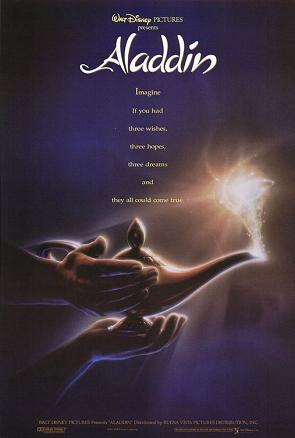 I thought we’d start off with one of the more basic, and useless, contemporary sociological theories: rational choice theory. This is basically economics. Humans engage in actions that will maximize profit – the most reward for the lowest cost. According to rational choice theory [RCT], humans are rational actors and will always make rational choices (and by rational, they mean profit-maximizing). Pretty easy, right? Hopefully you’ll pick up on some of the obvious flaws to the theory as we go along.
In Disney’s Aladdin, the main character is a thief because he can successfully avoid being captured and imprisoned while still getting food and other necessities without paying for them. Reward = free food; cost = risk of being caught; profit = large enough to make Aladdin rationally decide that stealing is worth it. It’s in his best interest to do so.
 Jasmine doesn’t want to get married (or, more specifically, to be obligated to get married). Why? Well, everyone has preferences. Jasmine prefers not to get married. Here’s a major flaw of RCT: it can’t, and doesn’t attempt to, explain why people want certain things; it just says that we all have preferences, and we seek to maximize those preferences. So Jasmine runs away from the palace because it helps her avoid being married off.
Jafar is pretty straightforward. He wants power. Selfish people are so easy to explain with RCT. (And, anyway, according to RCT we’re all self-interested.)
Here’s a brief plot summary, with 3 points I want to analyze: Aladdin steals some bread. Jasmine runs away from the palace to avoid marriage. Aladdin helps Jasmine in the market place. He is captured by the guards and imprisoned. Jafar (in disguise) gets Aladdin to steal the magic lamp. Genie grants Aladdin 3 wishes. Aladdin promises to use his third wish to free Genie from an eternity of servitude. Aladdin becomes Prince Ali and woos Jasmine on a magic carpet ride. The guards try to drown Aladdin but Genie saves him. Aladdin exposes Jafar’s power-hungry motives. Jasmine and Aladdin plan to marry. Jafar steals the magic lamp and becomes Genie’s new master. He wishes to be sultan, then sorcerer, then genie, after which he is imprisoned in his own lamp. Aladdin uses his third wish to free Genie. The sultan changes the law so Jasmine and Aladdin can marry.
 1. After Aladdin and Abu steal a loaf of bread and sit down to enjoy it, they see some little kids rooting through the trash for food. Aladdin generously hands over his half of the loaf. RCT says this is not real generosity; altruism does not exist (except for saints and fools, who are arguably not rational actors), which means that Aladdin is simply trying to appear noble because he prefers to be seen as such. Notice that Abu is reluctant to hand his bread over.
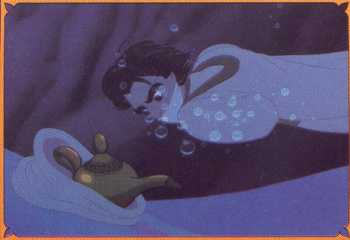 2. When Aladdin is thrown into the ocean by the guards, Genie frantically tries to get Aladdin to wish to be saved. Why? Is it because he cares about Aladdin as a friend, or because Aladdin has promised to free Genie with the third wish? Maybe both. Aladdin is a good master to Genie, which makes Genie want to keep him around. Perhaps for Genie the only thing better than having Aladdin as a master is being free. And by forcing Aladdin to use his second wish to avoid drowning, Genie hopes to guarantee his own sooner-than-later release from servitude. Of course, in the real world, we’d attribute Genie’s action to the bond he and Aladdin have formed, but RCT demands that we explain actions in terms of profit. Does Genie profit by saving Aladdin? He certainly avoids years of waiting in his lamp at the bottom of the ocean before being discovered by a new master.
 3. RCT is going to have a tough time satisfactorily explaining why Aladdin ends up freeing Genie with his third wish. It looks as though Aladdin gives up his chance to spend a happy life with Jasmine just to keep his promise to Genie. Sure, Aladdin’s a good guy, but what rational sense does that make? Here’s what RCT would say: Aladdin prefers keeping his word more than he prefers being happily married to the woman he loves. Or maybe Aladdin prefers appearing to be a good guy. Whatever it is, Aladdin is acting on his preferences.
In that last example, did you see the circular logic? Aladdin has preferences, and he acts to maximize them. We can see what his preferences are by examining his actions. So preferences motivate actions, and actions reveal preferences. If I stand outside in the rain, RCT says it must be in my self-interest to do so. If I come inside from the rain, RCT says it must be in my self-interest to do so. Which is my preference – standing outside or coming inside? RCT can only discern my preference by looking at my action, but then it explains my action by saying I was acting on my preference. Really, guys. This is a little ridiculous. Right?
Anyway, I want to apologize. This has turned out to be a little bit more of an undertaking than I imagined. It will take me a while to get the hang of what I’m doing with the sociological theory/movie analysis thing. I know this post was rambling and unorganized, but quite honestly I’ve had a long day and I don’t feel like sitting down to edit it. At least RCT can explain that easily!
 Jarom
Jarom Mika
Mika hilleries